Meshtastic vs MeshCore: Which LoRa Mesh Network Should You Actually Choose?
Meshtastic and MeshCore are both LoRa-based mesh communication projects. Both let you send encrypted text messages across radio nodes without relying on cell towers, Wi-Fi, or internet infrastructure. The hardware ranges from bare development boards to ready-made devices with screens and keyboards — and since both firmwares run on the same boards, the hardware cost is identical regardless of which protocol you choose. You will not stream video or make phone calls over LoRa, but you can push a short message across fifteen kilometers of open terrain.
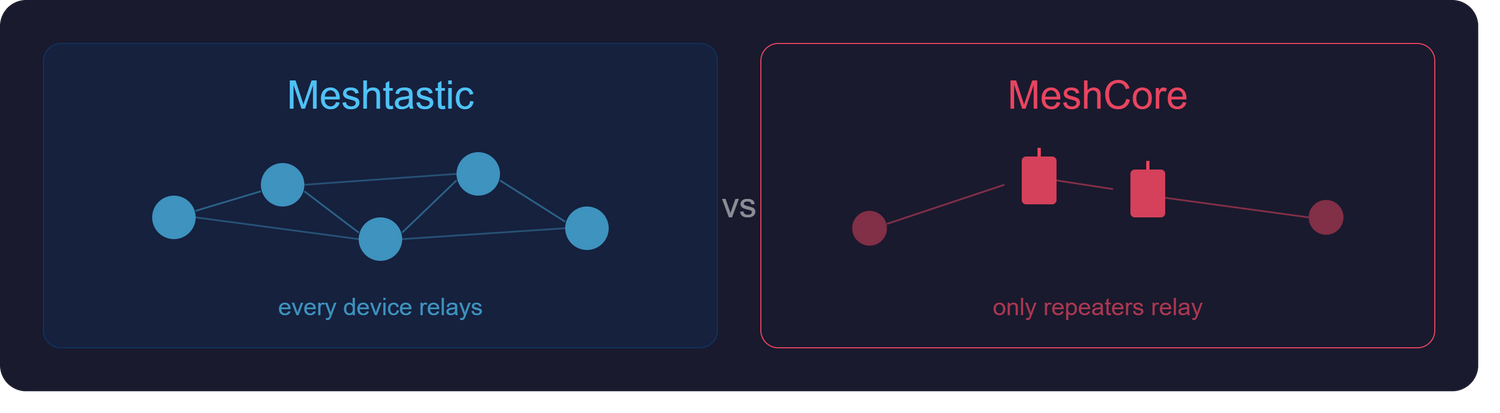
The two projects share the same goal but disagree on how to get there. In Meshtastic, every device does double duty: it handles your messages and also passes along messages from other people nearby. You turn it on, and the network assembles itself — no planning needed. In MeshCore, your personal device only handles your own messages. To carry messages across longer distances, someone has to install dedicated relay boxes — typically on rooftops or hilltops — that do nothing but forward traffic. Without those relay boxes, MeshCore devices can only talk to whoever is in direct radio range.
That one difference — whether your device helps carry other people's messages or not — shapes everything else about how the two systems work.
How Meshtastic works in 2026
Meshtastic started in 2019 as the side project of an American developer named Kevin Hester. The idea was elegant in its simplicity: flash open-source firmware onto an inexpensive LoRa board, pair it with a phone over Bluetooth, and start sending encrypted messages to anyone else running the same firmware. No infrastructure required. No operator. No license. Every device was both a user terminal and a relay. If your message couldn't reach its destination directly, it would bounce through whatever other nodes happened to be nearby, each one repeating the packet until it either arrived or ran out of hops.
This approach — called managed flooding — made Meshtastic almost absurdly easy to deploy. Hand a group of hikers five devices, turn them on, and the mesh builds itself. Nobody needs to know the topology. Nobody needs to plan anything. The protocol handles deduplication, prioritizes relays from nodes with weaker received signals (on the theory that a distant node will push the message farther), and decrements a hop counter to prevent infinite loops.
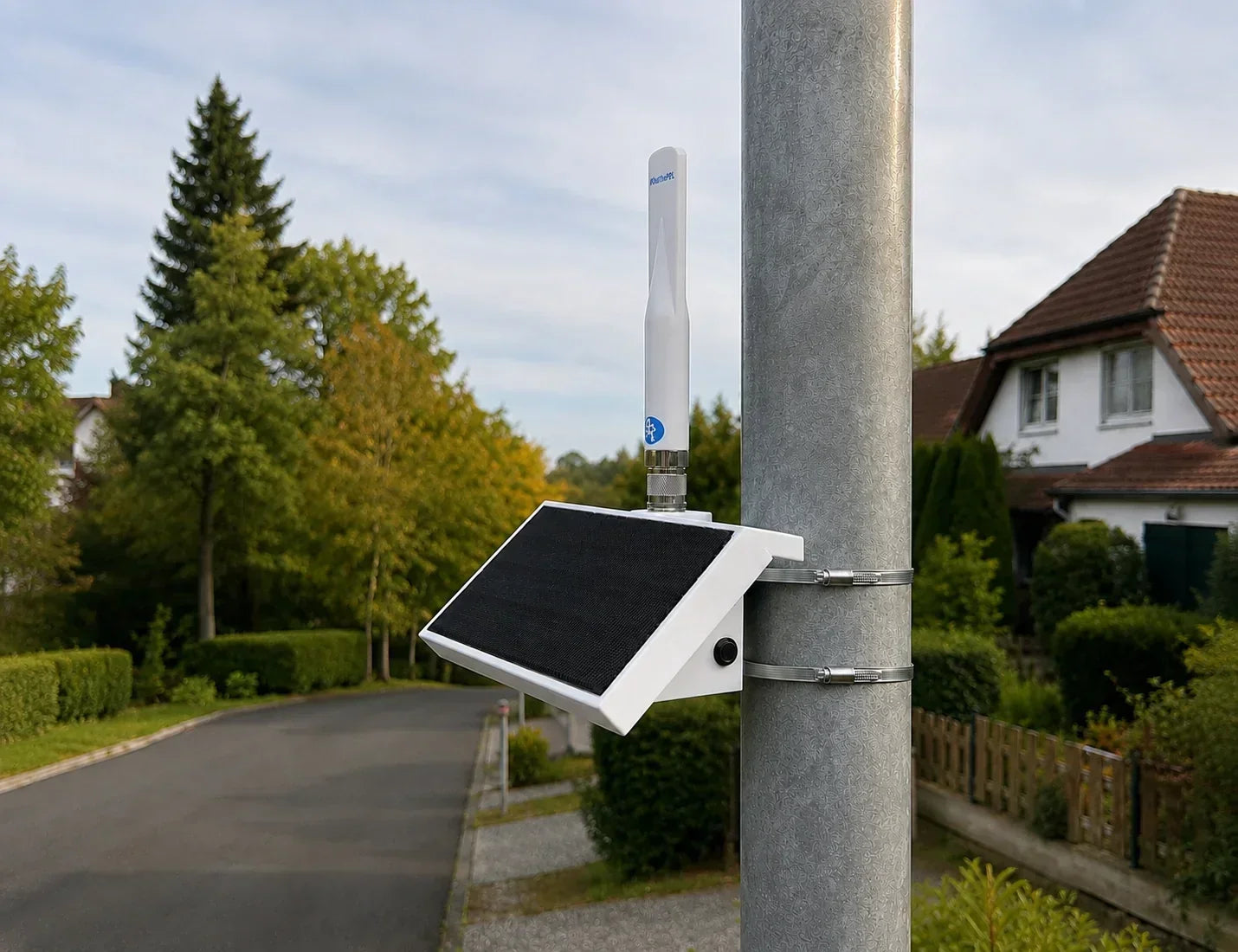
By 2024, the project had grown from a niche hobby into something that looked increasingly like critical infrastructure. Community groups were installing solar-powered nodes on rooftops in Washington, D.C. Burning Man participants coordinated across the playa using dozens of Meshtastic radios. After Cyclone Gabrielle devastated parts of New Zealand's North Island in February 2023, the experience galvanized local developers who saw firsthand what happens when cell towers go dark. By mid-2026, the project's GitHub repository had surpassed 40,000 stars, its subreddit counted more than 80,000 members, and active nodes were visible in hundreds of cities worldwide.
The appeal was partly technological and partly cultural. In an era of growing unease about centralized platforms and infrastructure fragility, Meshtastic offered something almost romantic: communication that answered to nobody.
But romance and radio physics don't always agree.
Where Meshtastic struggles at scale
LoRa is not Wi-Fi. It operates on a single shared radio channel at a fraction of the bandwidth. When a device transmits, every other device on the same frequency has to wait. Two devices transmitting simultaneously will collide and corrupt both packets. As mesh networks grew from a handful of nodes to dozens and then hundreds, this constraint started to bite.
In a Meshtastic network, every standard client node can relay traffic. That's a feature when five hikers need to bridge a canyon. It's a problem when two hundred urban nodes all try to repeat the same group message within milliseconds of each other. Add periodic GPS position broadcasts, telemetry from temperature sensors, node-info announcements, and the actual messages people are trying to send, and the shared radio channel starts to feel like a crowded room where everyone is shouting.
Meshtastic has tools to manage this — device roles like Client Mute and Router, configurable hop limits. But in a permissionless community mesh, there is no administrator. Anyone can set any role, crank up the hop limit, or enable GPS broadcasts that chew through available airtime. The protocol's greatest strength — that it just works without coordination — is also its most persistent vulnerability.
Version 2.6, released in early 2025, addressed part of the problem with a new routing algorithm for direct messages. Instead of flooding every DM, the protocol now learns the path a message took on its first successful delivery and remembers the next-hop relay. Subsequent DMs between the same two users travel a specific chain of nodes rather than washing across the entire mesh. If that path breaks, the system falls back to flooding and tries to discover a new route.
It was a significant architectural shift, and it moved Meshtastic closer to a position that another project had staked out from day one.
How MeshCore works differently in 2026
MeshCore appeared in early 2025, built by Scott Powell, an Australian developer and founder of a small hardware company called Ripple Radios, with application development from Liam Cottle in New Zealand and community infrastructure from Andy Kirby in the United Kingdom.
The project shared Meshtastic's hardware ecosystem — the same ESP32-based boards, the same LoRa transceivers, the same license-free frequency bands. What it did not share was Meshtastic's philosophy about who should repeat traffic.
MeshCore's central architectural decision is a strict separation between clients and infrastructure. A Companion device — the node a user carries and pairs with a phone — does not relay other people's packets by default. Relaying is the job of dedicated Repeaters: devices that are purpose-installed, typically on rooftops or hilltops, with permanent power and good antennas. A third role, the Room Server, functions as an autonomous message board that stores messages and delivers them to users who connect later, even if the sender has long since gone offline. There is an opt-in feature called Off-Grid Repeat that lets Companions relay temporarily — useful for a group in the field without infrastructure — but it's explicitly designed as a temporary measure, not the normal operating mode.
This design reflects a fundamentally different bet about how mesh networks should scale. Meshtastic bets on spontaneity: every node is a potential relay, and the mesh self-organizes. MeshCore bets on planning: a smaller number of well-placed infrastructure nodes will carry traffic more efficiently than a crowd of mobile devices that may or may not be in useful positions.
The routing difference is sharpest after the first message. When a MeshCore user sends a direct message to someone they've never reached before, the system floods the packet through available Repeaters — similar to Meshtastic's approach. But when the recipient acknowledges receipt, the delivery report carries the exact sequence of Repeaters the message traversed. The sender stores that path. Every subsequent direct message embeds the relay chain directly in the packet header — the message itself carries its own map. Each Repeater along the path checks whether it's the next stop; if yes, it forwards the packet. If not, it ignores it.
The result, when infrastructure is stable, is dramatically less radio chatter and noticeably faster delivery. One community mesh in Austin, Texas, reported sub-second delivery between nearby peers and roughly five seconds across a nine-hop route — against ten to twenty seconds for Meshtastic over comparable topology.
What Meshtastic and MeshCore both get wrong
Neither system has solved the fundamental physics of LoRa. Group messages — broadcast to a channel rather than addressed to a specific user — are flooded in both protocols, because there's no single destination to route toward. An active group chat will saturate a LoRa channel whether the firmware is stamped Meshtastic or MeshCore.
MeshCore's memorized paths are efficient only as long as the Repeaters stay put. In a mobile scenario — a convoy, a search-and-rescue operation, an event where people and equipment keep moving — those cached routes go stale quickly. Meshtastic, where routes are always somewhat provisional and flooding is never far away, handles constant movement more gracefully.
Security is another area where both projects are honest about their limitations. By default, messages in both systems are encrypted over the air — but the default encryption keys are public, which means anyone with the same firmware can listen. For actual privacy, both offer ways to set up private channels or encrypted direct messages. Neither claims to offer the same level of security as Signal or WhatsApp. The practical takeaway: good enough to keep casual listeners out, not strong enough to bet your life on.
Meshtastic vs MeshCore: ecosystem, apps, and cost
This is where a reader choosing between the two should pay close attention, because the differences are not just technical — they're practical and financial.
Meshtastic is entirely free and open source under the GPL license. Every app, every firmware, every tool — free to use, free to modify, and any fork must remain open source. The phone apps are polished, map-centric, and feel like a finished consumer product. The platform natively supports GPS tracking, environmental sensors, internet bridging for connecting separate LoRa networks, Home Assistant integration, and a growing library of automation tools. Meshtastic is less a chat application than a general-purpose LoRa platform that happens to do chat well.
MeshCore's core firmware is open source under the MIT license, but the mobile apps and the T-Deck standalone firmware are proprietary. The phone apps are functional and actively updated, but they require a small one-time payment to unlock the full feature set. The app experience feels more infrastructure-oriented — built around managing a radio network rather than casual chatting. MeshCore's sensor and integration support exists but is thinner: it has a custom Home Assistant integration, but no native internet-bridging equivalent to Meshtastic's built-in capability. Its community, while passionate, is an order of magnitude smaller — roughly 6,000 Discord members versus Meshtastic's 40,000.
Where MeshCore stands out beyond messaging is IoT. Its architecture — low airtime, non-repeating clients, structured repeater placement — makes it genuinely practical for tracking assets across a shipping yard, monitoring soil moisture on a farm, or watching the status of refrigerated containers in a port. These aren't theoretical use cases; they're scenarios where Meshtastic's chattier mesh design struggles with the overhead from hundreds of quiet sensor nodes.
Meshtastic or MeshCore: how to choose
Everything in this article flows from one architectural difference. In Meshtastic, every device relays traffic by default. In MeshCore, only dedicated Repeaters relay; your personal device does not. That single decision shapes what each system can and cannot do.
Here are the hard facts (✓ yes, native · ◐ possible, but limited · — no):
| Capability | Meshtastic | MeshCore |
|---|---|---|
| Multi-hop mesh works without any dedicated infrastructure | ✓ | — |
| Client devices separated from relay infrastructure | — | ✓ |
| Offline message board (leave a message, pick it up later) | ◐ | ✓ |
| GPS tracking, environmental sensors (built-in, mature) | ✓ | ◐ |
| Internet bridging, Home Assistant, automation | ✓ | ◐ |
| Reliable delivery confirmation (clear yes or no) | ◐ | ✓ |
| IoT / industrial sensor networks at scale | ◐ | ✓ |
| Up to 64 relay hops | — | ✓ |
| Polished, consumer-friendly phone app | ✓ | ◐ |
| Everything free and open source (firmware + apps) | ✓ | ◐ |
| Large community, extensive documentation | ✓ | ◐ |
| Runs on the same hardware | ✓ | ✓ |
Now the decision. Ask yourself these questions in order — stop at the first one where your answer is clear.
Is there already a mesh network where you live? Check public node maps like meshmap.net for Meshtastic or meshcore.co.uk/map for MeshCore. If your area has an active network, join it. A protocol with nobody to talk to is a radio with a nice antenna.
Do you need it to work right now, with zero infrastructure? Hiking trip, festival, emergency response where you hand out radios. Only Meshtastic does this — every device relays out of the box.
Are you ready to install and maintain rooftop repeaters? If yes, MeshCore rewards that effort with a quieter, faster network. If no — if you can't or don't want to mount hardware on a roof, run power to it, and maintain it — MeshCore without repeaters isn't a mesh. Choose Meshtastic.
Do you need GPS tracking, sensors, or integration with home automation? Both can do it. Meshtastic's support is mature and native. MeshCore's exists but takes more work.
Do you need to track hundreds of sensor nodes — containers, equipment, soil probes? MeshCore's low-airtime architecture handles large numbers of quiet devices more efficiently.
Is this for emergency preparedness? Both work, with a caveat. MeshCore's pre-planned repeaters and Room Servers are excellent as long as they survive the disaster. But a storm that flattens cell towers can flatten rooftop repeaters too. When the infrastructure is gone, Meshtastic's architecture means every surviving device still relays. For the true worst case, Meshtastic degrades more gracefully.
Does it matter that everything is free? Meshtastic is entirely free and open source. MeshCore's firmware is free, but the phone apps charge a small fee for full features.
Still not sure? Start with Meshtastic. Larger community, more documentation, easier first experience. Both firmwares run on the same boards — flash MeshCore tomorrow if you outgrow it.
The future of Meshtastic and MeshCore
The real significance of the Meshtastic-MeshCore split extends beyond the hobby community. In April 2025, a massive blackout across Spain and Portugal left millions without communication for hours — mobile networks failed alongside the grid. Events like these have pushed off-grid communication from the fringes of the prepper community into mainstream emergency planning.
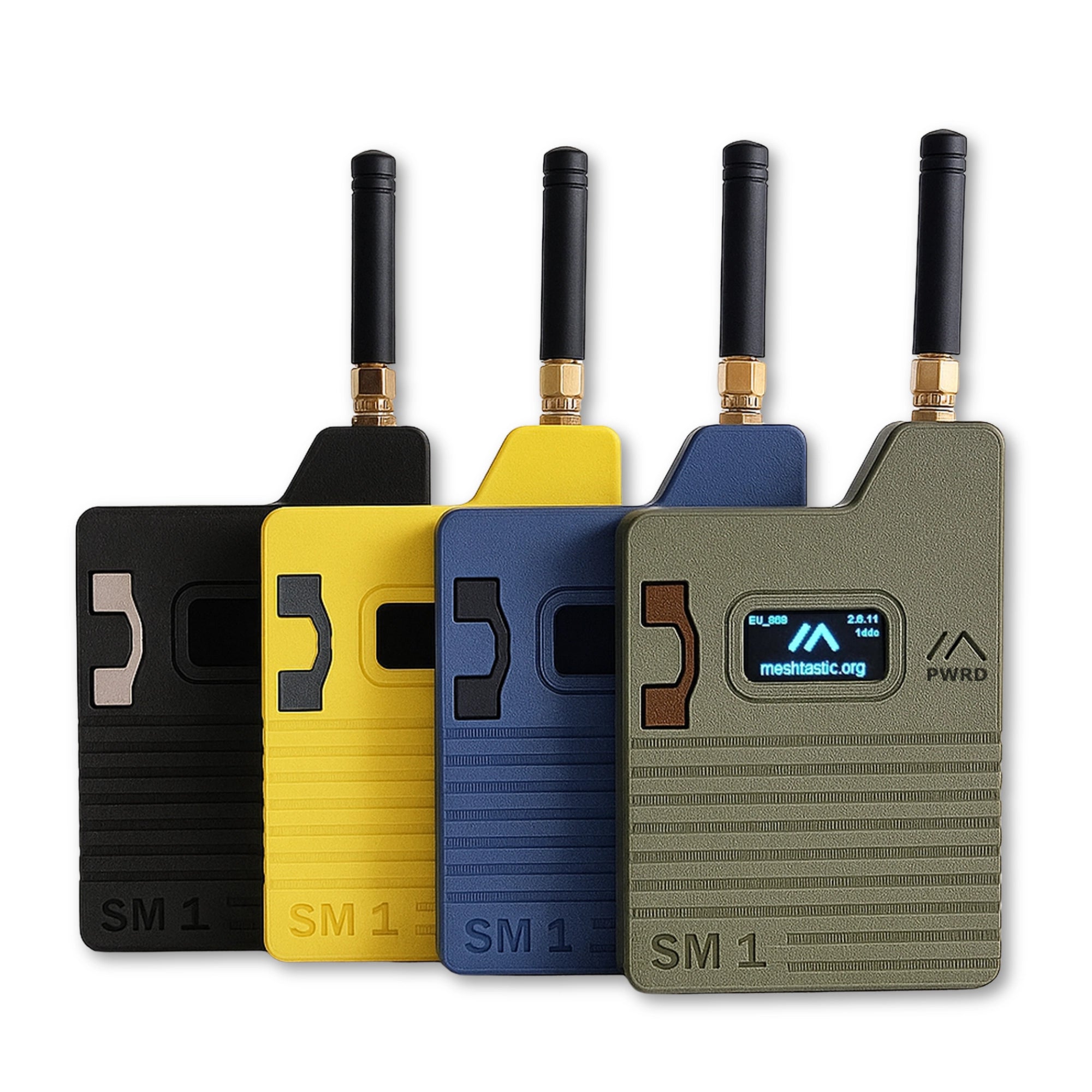
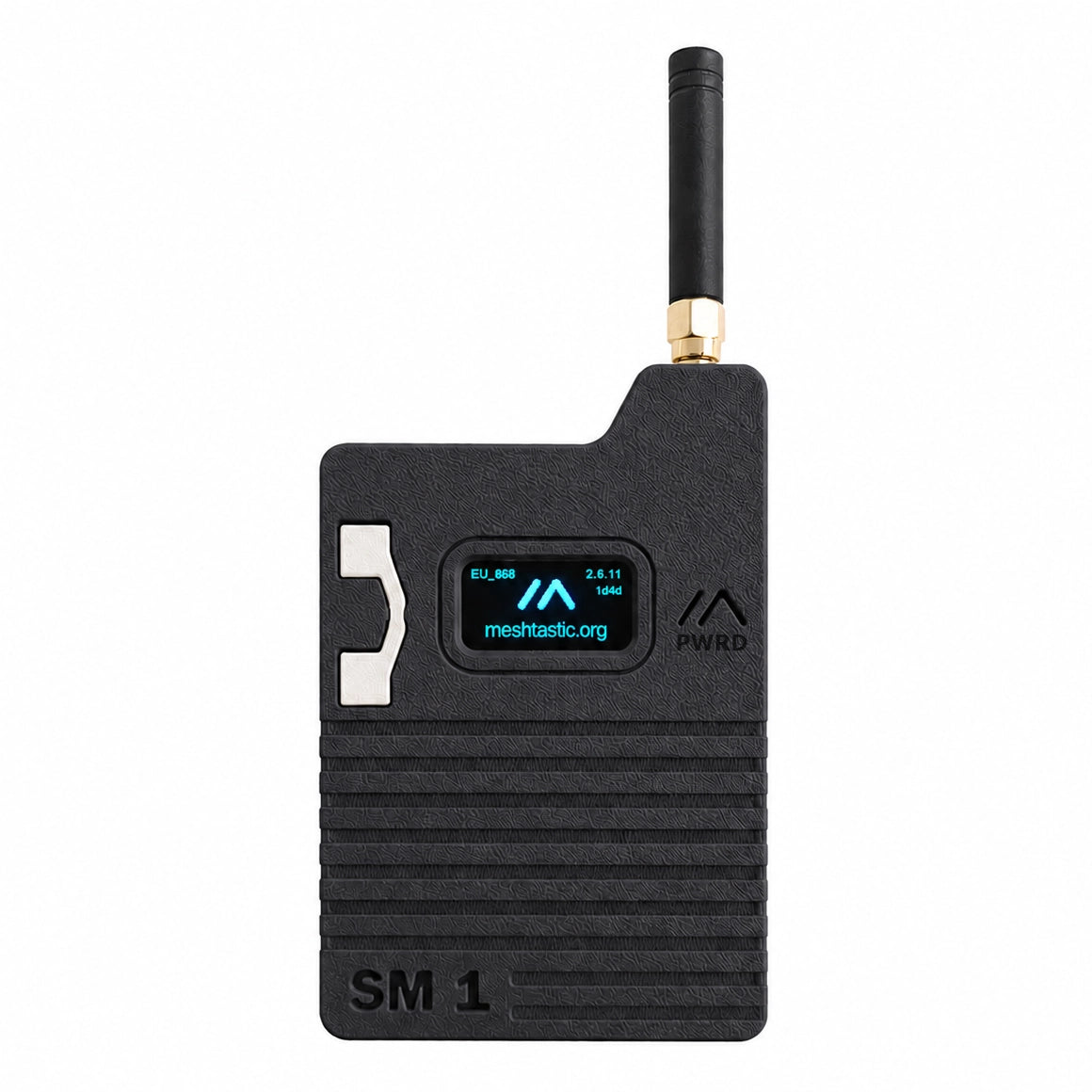
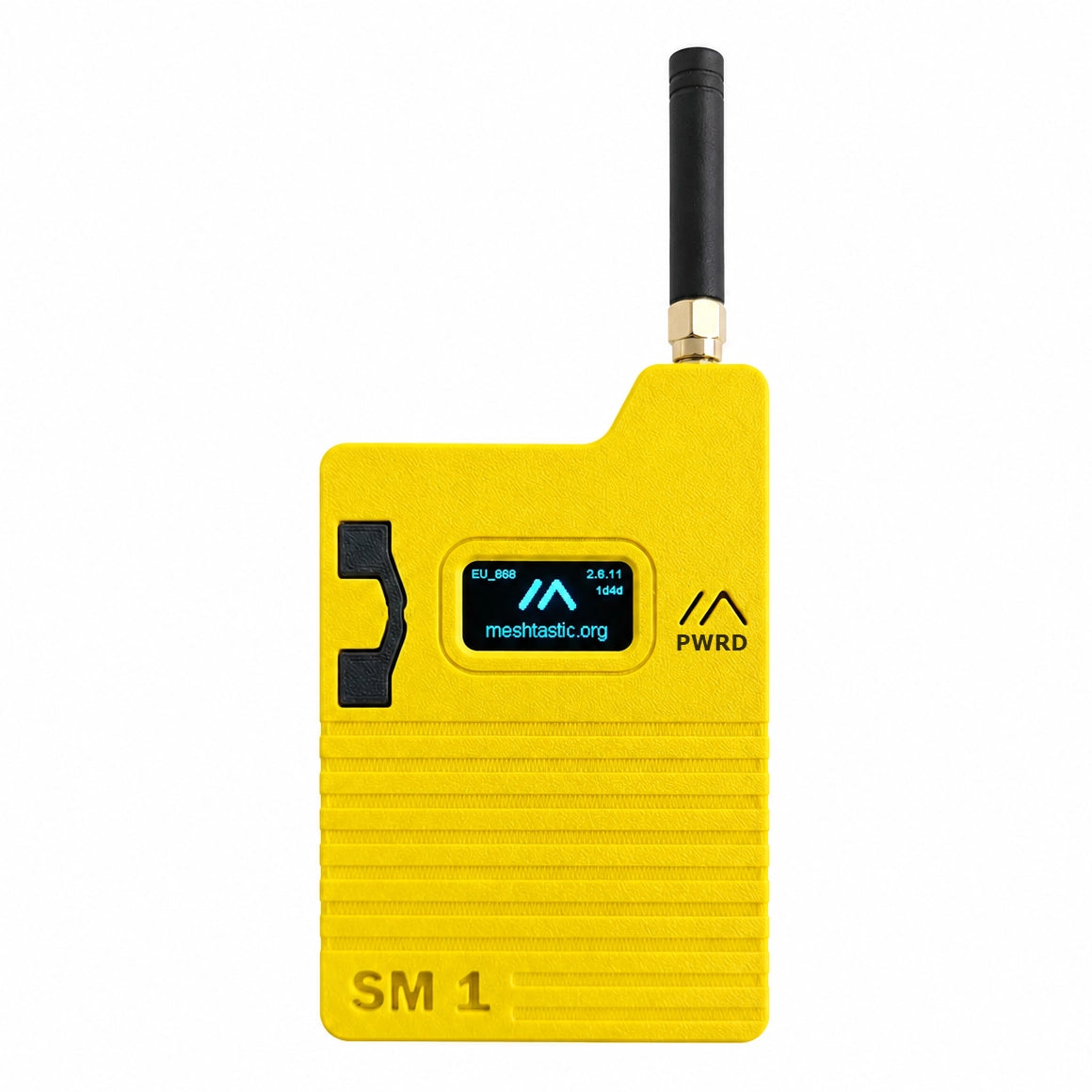
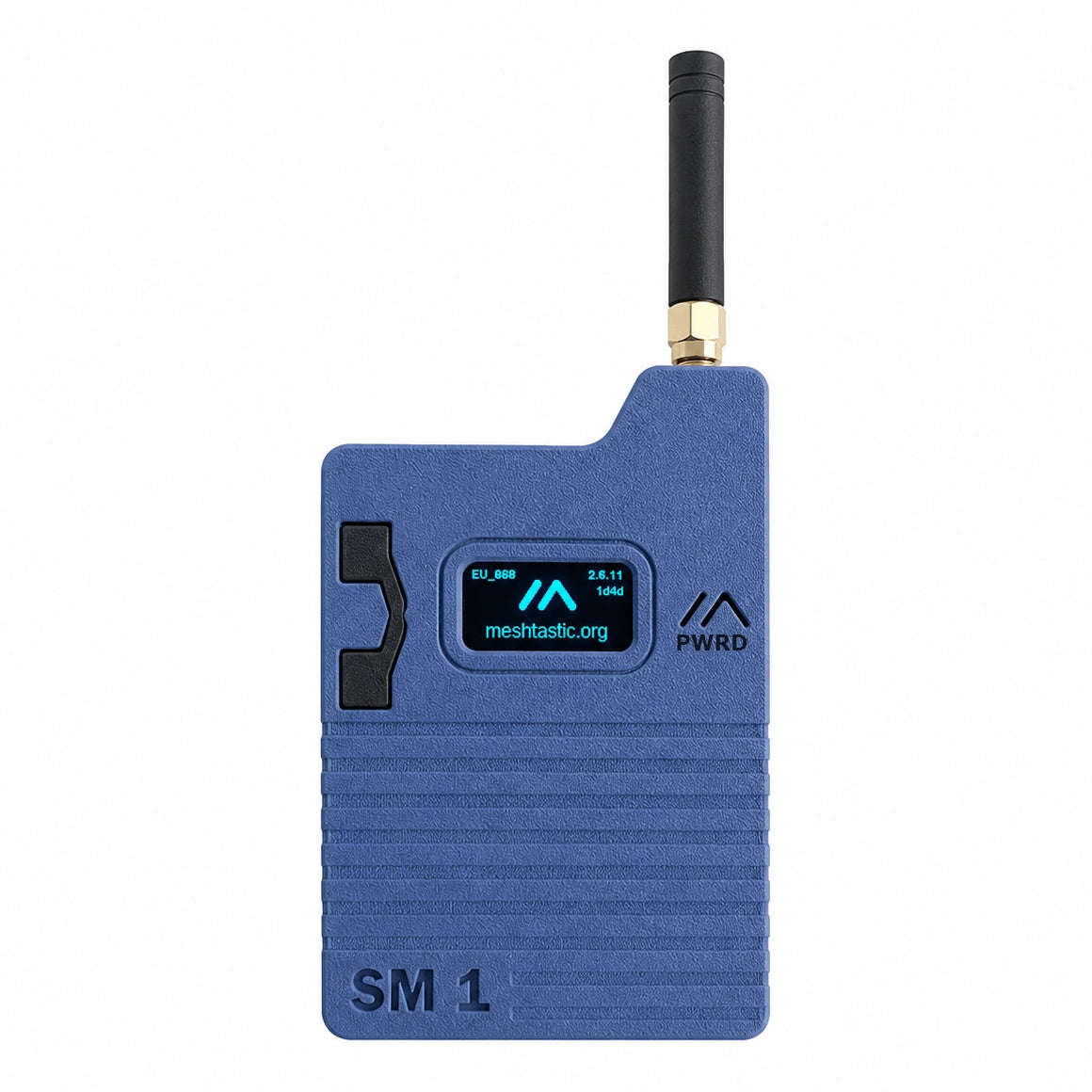
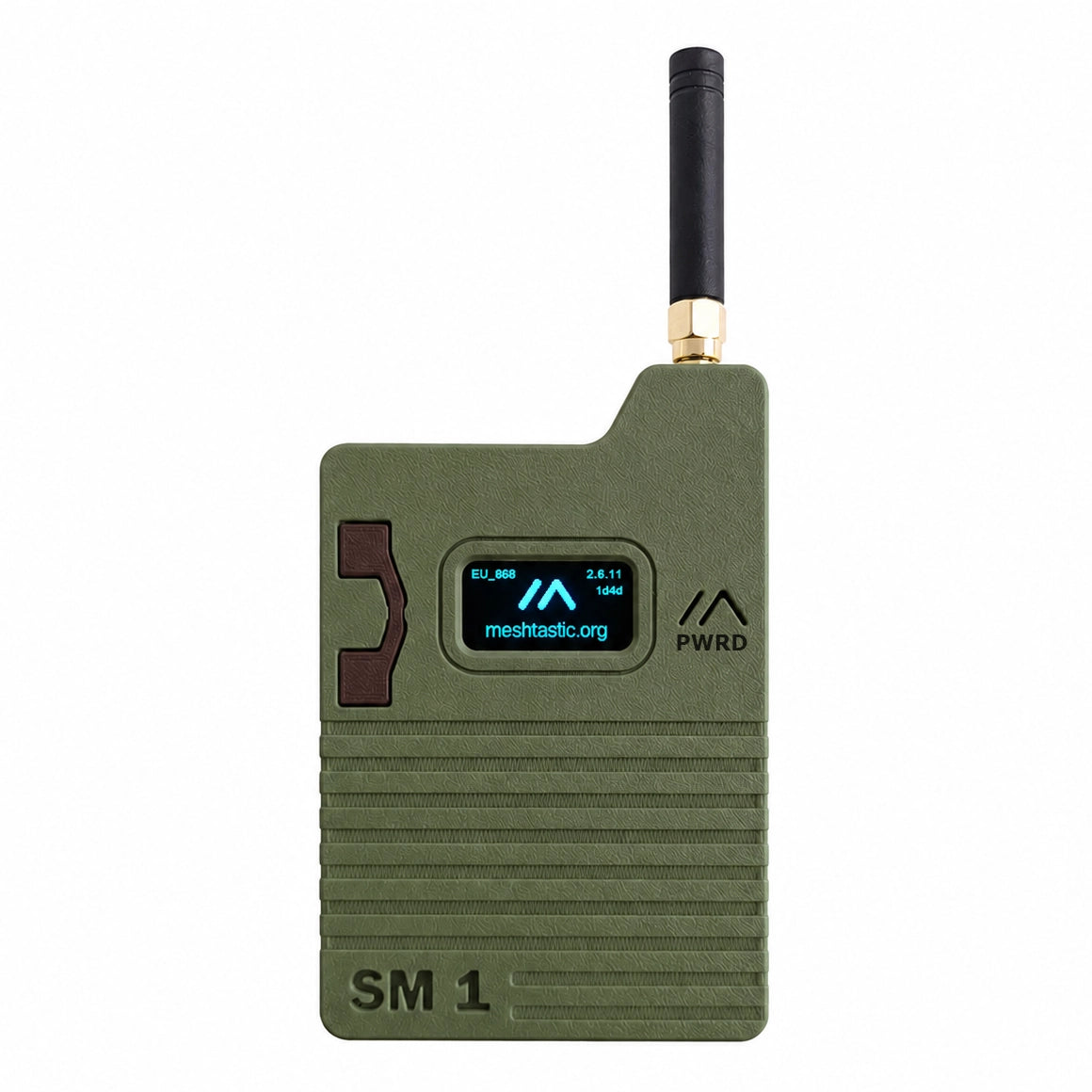
Both projects are evolving fast. Meshtastic's version 2.7 is in preview. MeshCore's firmware updates weekly. Hardware manufacturers are shipping pre-flashed devices — our SmartnMagic Meshtastic Slim edition ships ready to join a Meshtastic network out of the box.
Find your question in the list above, follow the answer, flash the firmware. The rest is radio waves doing what they've always done — carrying messages for people who need to be heard.