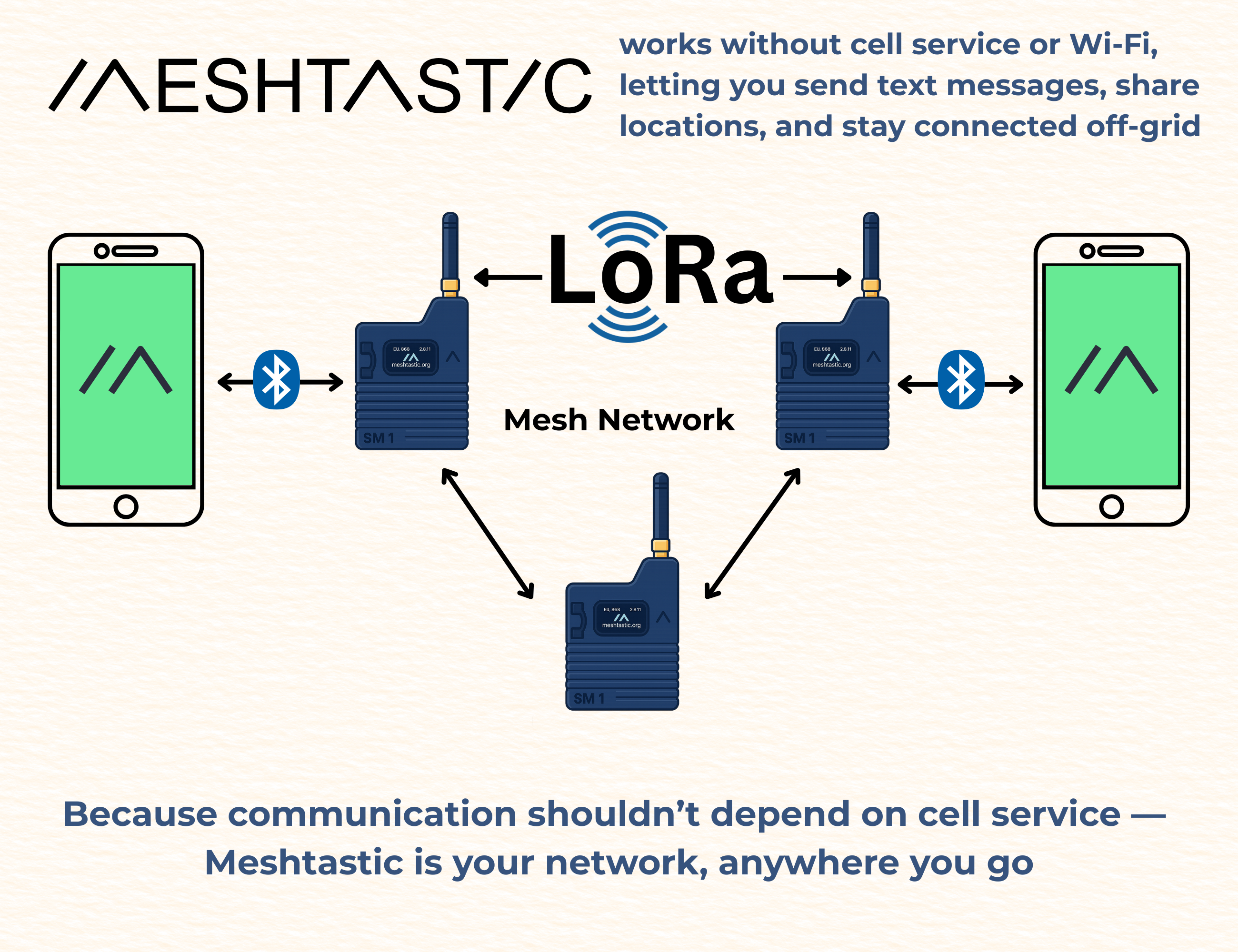
Meshtastic is an open-source project that enables long-range, off-grid communication using inexpensive LoRa radio hardware. By forming a decentralized mesh network, Meshtastic devices can relay encrypted text messages, GPS positions, and telemetry data over distances of several kilometers — without any reliance on cellular towers, Wi-Fi, or internet infrastructure.
Choosing the right Meshtastic hardware is one of the most important decisions for anyone entering this ecosystem. The range of supported devices now exceeds 100 distinct hardware variants from manufacturers around the world. This guide provides a comprehensive overview of the Meshtastic hardware landscape: microcontroller platforms, LoRa radio chipsets, device categories, and specific products from every major manufacturer. Whether you are a first-time user looking for an affordable entry point, a network operator planning solar-powered repeater stations, or a developer building a custom solution, this article will help you make an informed decision.
Core Technology: MCUs, LoRa Chips & Frequencies
Microcontroller Platforms
Meshtastic firmware runs on three main microcontroller families, each with distinct strengths and trade-offs.
ESP32 / ESP32-S3 (Espressif Systems). The most commonly used MCUs in Meshtastic hardware. They offer dual-core processing at up to 240 MHz, built-in Wi-Fi and Bluetooth, and generous RAM and flash. The Wi-Fi capability is particularly valuable for MQTT gateway configurations, where a node bridges the mesh network to the internet. However, ESP32 chips draw significantly more power than alternatives — typical current in LoRa receive mode ranges from 40 to 80 mA — making them less suitable for battery-powered or solar deployments where runtime is critical.
nRF52840 (Nordic Semiconductor). The preferred MCU for power-sensitive applications. It features Bluetooth 5.0 (but no Wi-Fi), an ARM Cortex-M4 processor at 64 MHz, and exceptionally low power consumption. Some nRF52840-based devices draw as little as 11 microamps in deep sleep, enabling multi-day operation on modest batteries and making them ideal for solar-powered repeaters and handheld units. Firmware updates are performed via simple UF2 drag-and-drop or OTA via Bluetooth.
RP2040 (Raspberry Pi Foundation). A newer addition found primarily on Raspberry Pi Pico-based boards. It offers a flexible dual-core ARM Cortex-M0+ platform at 133 MHz. Still a niche option with fewer commercially available devices, it provides a cost-effective platform for custom integrations.
Linux Native (Raspberry Pi). Meshtastic also supports a Linux-native build called meshtasticd that runs on Raspberry Pi single-board computers. This requires an external SPI LoRa HAT or USB LoRa adapter and opens possibilities for integration with home automation, sensor networks, and custom software that would be impractical on a microcontroller.
LoRa Radio Chipsets
The LoRa radio is the heart of every Meshtastic device. Two generations of Semtech LoRa transceivers are commonly used:
SX1262 / SX1268 (recommended). The current generation offering improved sensitivity, better power efficiency, and wider frequency flexibility. The SX1262 is used for 868/915 MHz devices; the SX1268 supports lower frequencies. The vast majority of currently manufactured Meshtastic hardware uses SX126x chips, and the project strongly recommends them.
LR1110 / LR1120 (advanced). Semtech's LR11xx series adds GNSS scanning and Wi-Fi scanning capabilities directly on the LoRa transceiver, enabling low-power geolocation without a separate GPS module. Devices like the SenseCAP T1000-E and Elecrow ThinkNode M3 use the LR1110. Note: LR1110 radios currently cannot receive packets from the older SX127x devices.
SX1276 / SX1278 (legacy). The older generation that powered the earliest LoRa devices. Less power-efficient and with reduced sensitivity compared to SX126x. The Meshtastic project advises against purchasing new SX127x-based hardware.
Frequency Bands and Regional Regulations
LoRa operates in license-free ISM bands that vary by region. When purchasing a Meshtastic device, it is essential to select the correct frequency variant for your location: 915 MHz for North America and Australia, 868 MHz for Europe, 433 MHz for certain Asian regions. Using the wrong frequency band is not only illegal in many jurisdictions but also means your device will not communicate with other nodes in your region.
Antennas: The Most Important Accessory
The antenna is arguably the single most impactful factor in determining a node's effective range. A quality antenna matched to the correct frequency can double or triple range compared to a cheap stock stub. Key considerations include connector type (SMA, RP-SMA, or built-in), gain (measured in dBi), radiation pattern (omnidirectional for general use, directional for point-to-point links), and physical mounting height.
Never power on a LoRa device without an antenna connected. Transmitting without a load can permanently damage the radio module.
Hardware Manufacturers and Their Devices
RAKwireless: WisBlock & WisMesh
RAKwireless is one of the most established names in the Meshtastic ecosystem, offering both a modular development system (WisBlock) and ready-to-use products (WisMesh). The company is an official Meshtastic hardware partner.
WisBlock Modular System. Users assemble custom nodes by combining base boards, core MCU modules (typically the nRF52840 + SX1262-based RAK4631), and peripheral add-ons. Base boards like the RAK19007 provide slots for a display, GPS module, motion sensor, and additional sensor modules (RAK1901 for temperature/humidity, RAK1902 for barometric pressure, RAK1906 for environmental sensing). The Meshtastic Starter Kit remains one of the most popular entry points, shipping with a pre-flashed nRF52840 core and a 2 dBi rubber antenna.
WisMesh Series. For users who prefer complete devices: the WisMesh Pocket (handheld with screen), WisMesh Tap (touchscreen with Meshtastic UI), and solar-powered repeaters including the RAK10721 (5.2 Ah battery, IP67 enclosure) and a lighter 3200 mAh variant.
RAKwireless devices are generally considered the gold standard for solar and router deployments due to nRF52840 efficiency, extensive modularity, and well-tested reliability.
LILYGO: T-Beam, T-Echo, T-Deck & More
LILYGO is the most prolific manufacturer in the Meshtastic space, offering a wide variety of boards spanning different use cases and price points.
T-Beam & T-Beam Supreme. The T-Beam is one of the most iconic Meshtastic devices and frequently the first recommendation for newcomers. The original features an ESP32, SX1262 LoRa radio, integrated GPS, and an 18650 battery holder. The T-Beam Supreme upgrades to ESP32-S3 with 8 MB flash/8 MB PSRAM, a six-axis IMU, and a 1.3-inch OLED. Pricing ranges from ~$25 to ~$50.
T-Echo. Uses the nRF52840 for low power consumption and features an e-ink display for sunlight readability. Comes in an injection-molded case with integrated GPS — a complete out-of-the-box solution for outdoor use. Priced around ~$60.
T-Deck & T-Deck Plus. A pocket-sized unit with a 2.8-inch IPS LCD touchscreen (320×240 pixels), physical QWERTY mini-keyboard, and ESP32-S3 with 16 MB flash. Enables standalone messaging without a paired smartphone. The Plus adds GPS and a 2000 mAh battery. A newer T-Deck Pro offers e-ink for lower power draw. Ideal for self-contained communicators.
T-LoRa Pager. A compact messaging device with screen and basic input, optimized for text communication over the mesh.
LoRa32 Series (T3-S3). Versatile ESP32-S3 development boards with SX1262 and small OLED. Lack GPS and battery holders — suited for fixed installations and development.
Heltec Automation: LoRa V3, V4 & Mesh Node T114
Heltec produces some of the most affordable Meshtastic-compatible boards, making them a very popular entry point for both budget-conscious users and vendors building assembled solutions.
Heltec WiFi LoRa 32 V3 (Heltec V3). An ESP32-S3-based board with SX1262 LoRa and a 0.96-inch OLED display. One of the most affordable ways to start with Meshtastic, often available for under $20 as a bare board. Includes Wi-Fi and Bluetooth — suitable for MQTT gateways. Does not include GPS or battery, though both can be added. Note: USB-C to USB-C charging may have issues; USB-A to USB-C is recommended.
Heltec WiFi LoRa 32 V4. The next generation, retaining V3's size and pinout while adding a built-in Wi-Fi/Bluetooth antenna, up to 28 dBm LoRa output power, solar panel connector, GNSS connector, 2 MB PSRAM, 16 MB flash, and a protected OLED display.
Heltec Mesh Node T114. Heltec's entry into the nRF52840 market and a community favorite. Features nRF52840, SX1262, optional 1.14-inch color TFT-LCD display (135×240, 262K colors), and connectors for LiPo battery, solar panel, and external GNSS. Deep sleep at just 11 µA (23 µA in Meshtastic sleep) makes it extraordinarily efficient. Rev 2.0 addressed earlier reliability issues. Pricing starts ~$15 for bare board, ~$30–40 for kits.
Vision Master & Wireless Paper. E-ink-based boards for developers wanting always-on, low-power displays. Niche products expanding the range of available form factors.
Seeed Studio: SenseCAP & Wio Series
Seeed Studio brings a polished, consumer-oriented approach with products ranging from card-sized trackers to industrial-grade nodes.
SenseCAP Card Tracker T1000-E. One of the most remarkable devices in the ecosystem. Barely larger than a credit card and IP65-rated, it packs an nRF52840, Semtech LR1110 with GNSS, Mediatek AG3335 GPS, temperature sensors, and a 700 mAh battery into a sealed package. Pre-installed Meshtastic firmware, magnetic pogo-pin charging. Priced at ~$40 with reliable urban range approaching 2 km. Widely regarded as the best out-of-the-box tracker available.
SenseCAP Indicator. A 4-inch touchscreen device with dual-MCU (ESP32-S3 + RP2040) for desktop/wall-mounted mesh network monitoring.
SenseCAP Solar Node. Weather-resistant with integrated solar charging, built for autonomous outdoor repeater and router roles.
Wio Tracker L1 Pro. A ready-to-go handheld with joystick navigation, BaseUI support, 1.3-inch OLED, GPS with multi-constellation support, buzzer, 2000 mAh battery, and solar charging — all for ~$43 with included 3D-printed enclosure.
B&Q Consulting (Unit Engineering): Nano & Station Series
B&Q Consulting produces some of the most technically sophisticated Meshtastic hardware, with a particular focus on RF performance engineering.
Nano G2 Ultra. A portable device built around nRF52840 + SX1262 with a custom wideband internal antenna (815–940 MHz) engineered to compensate for body-proximity effects. Uses a high-precision TCXO (±1.5 ppm) for reliable narrow-bandwidth operation. Achieves ~5 days battery life, supports I2C sensors via extension board, and updates via UF2 drag-and-drop. Priced around ~$70.
Station G2. In a class of its own for raw RF performance. Features a 35 dBm PA (3.16 W at P1dB, max output 4.46 W on US915 / 5 W on EU868), ultra-low noise LNA improving receive sensitivity by ~4 dB over typical devices, and a fast-transient DC-DC converter. Powered by ESP32-S3, it has a rugged SMA socket and runs from USB-C PD at 15V or 9–19V DC external supply. Widely deployed as backbone infrastructure in community meshes. Operating above 1 W in the US requires an FCC Amateur Radio license (Part 97). Priced ~$100+.
Elecrow: ThinkNode & CrowPanel Series
ThinkNode M1. Compact nRF52840 device with SX1262, built-in GPS, 1.54-inch e-ink display, 1200 mAh battery, buzzer, and rotary encoder. Ships with Meshtastic pre-installed. Excellent battery life. ~$40.
ThinkNode M2. ESP32-S3 variant with SX1262, 1.3-inch OLED, and 1000 mAh battery. Trades power efficiency for Wi-Fi capability.
ThinkNode M3. Card-style tracker using nRF52840 + LR1110 with built-in GNSS, temperature/humidity/accelerometer sensors, 770 mAh battery, magnetic pogo-pin charging, and IP66-rated waterproof enclosure. Competes directly with the SenseCAP T1000-E. ~$35.
CrowPanel Advance Series. Larger-display devices aimed at fixed installations for visual monitoring of network activity.
Assembled & Ready-to-Use Vendors: Smartnmagic, muzi works & Others
Not everyone wants to solder, flash firmware, or print a case. A growing number of vendors specialize in fully assembled, tested, and ready-to-use Meshtastic nodes that work out of the box.
Smartnmagic
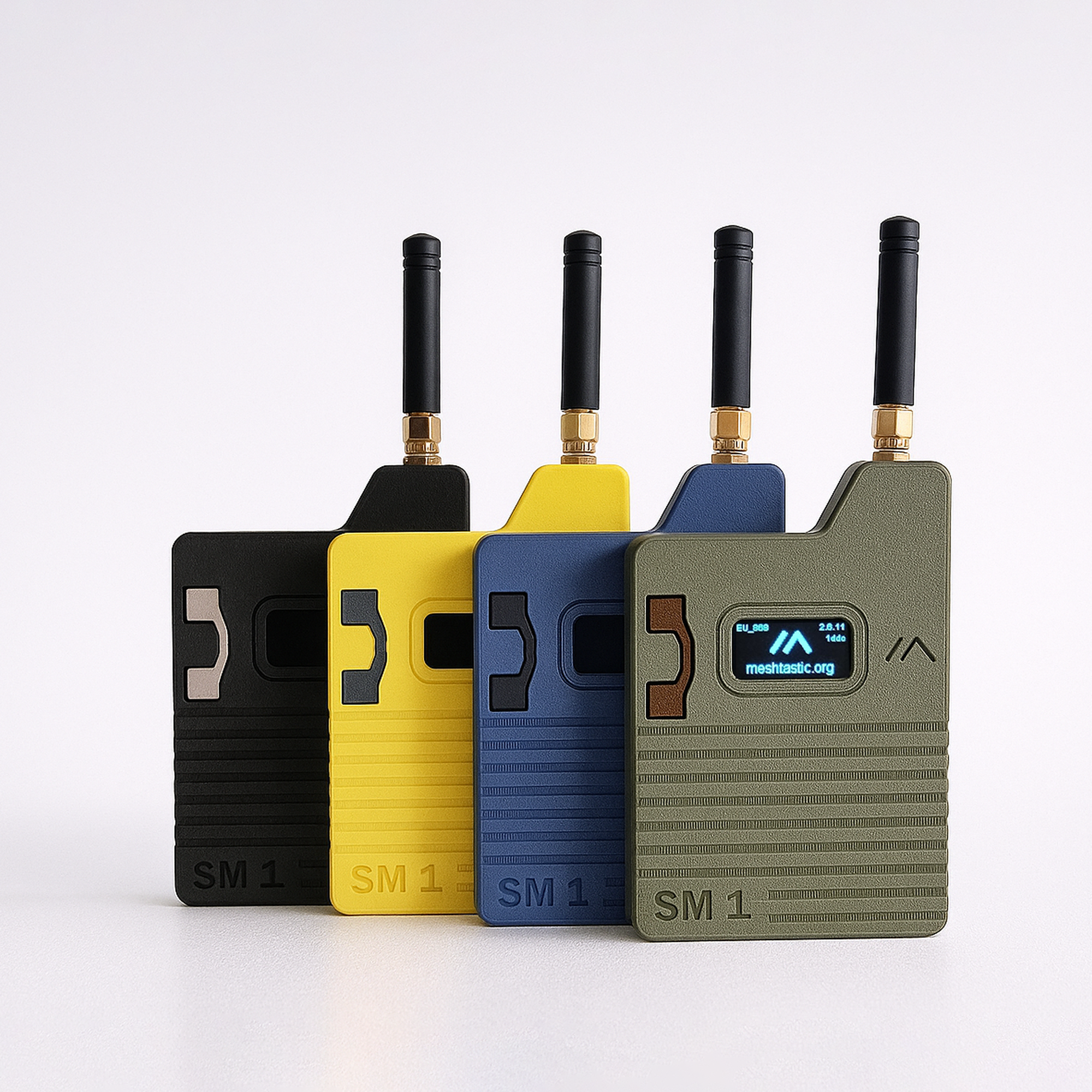
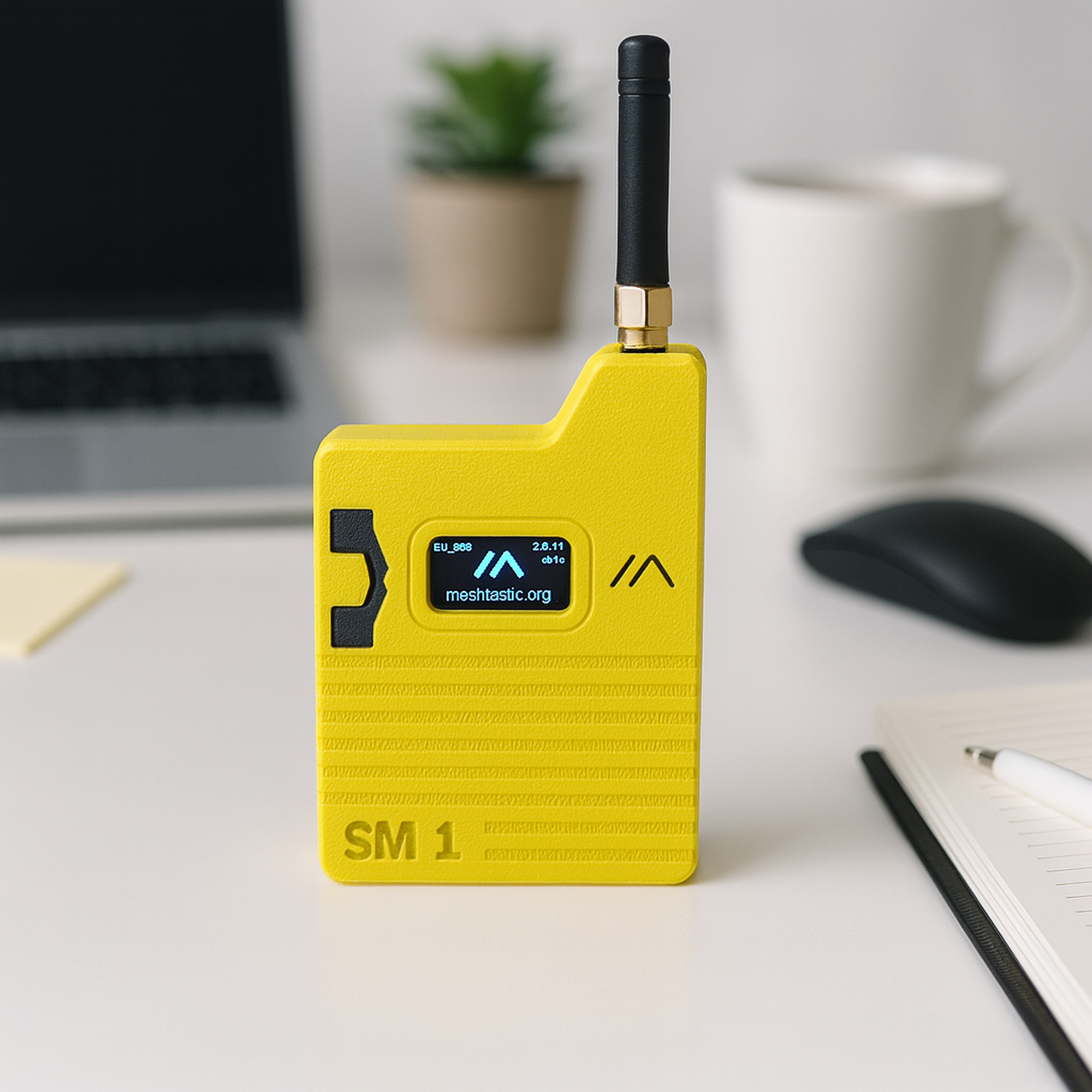
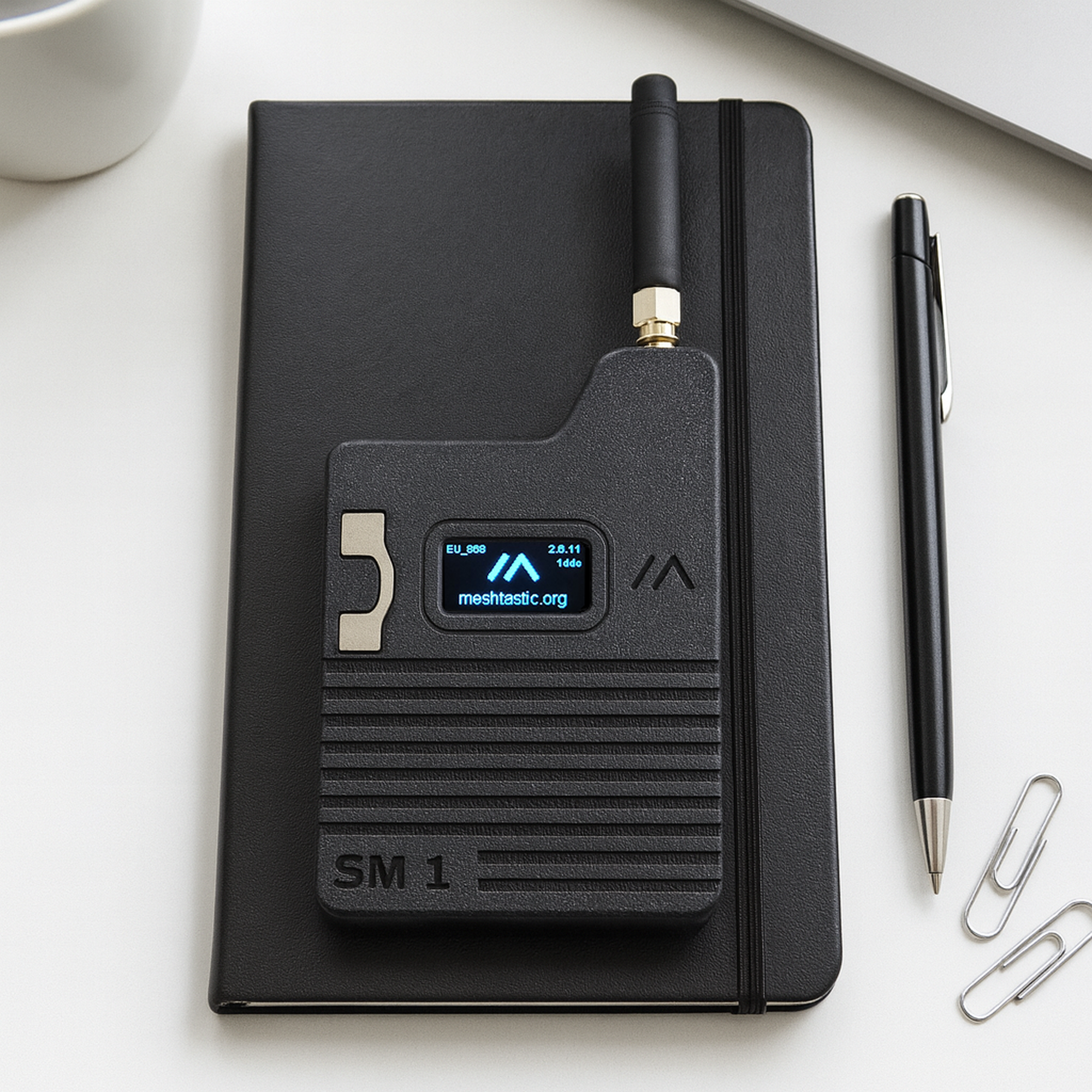
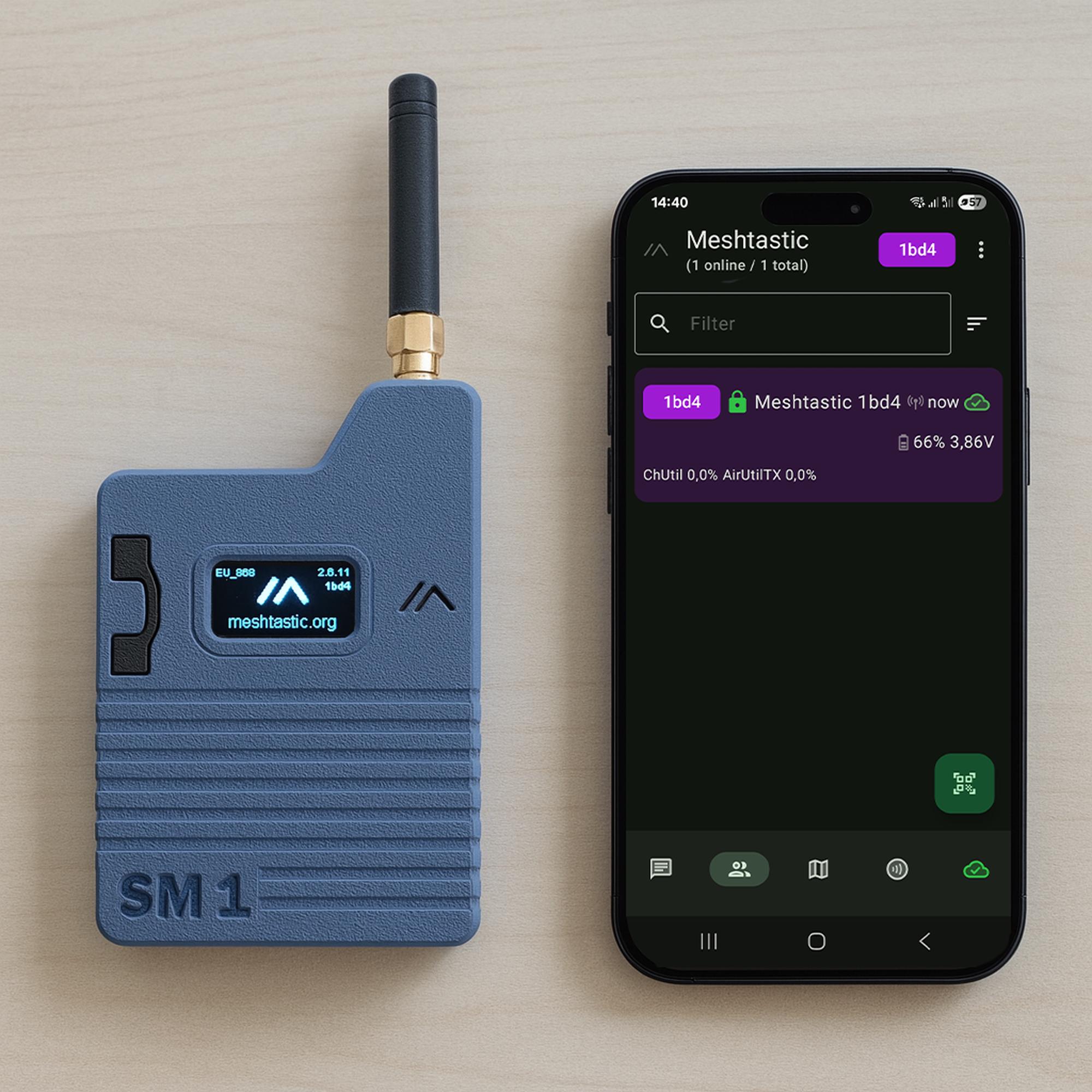
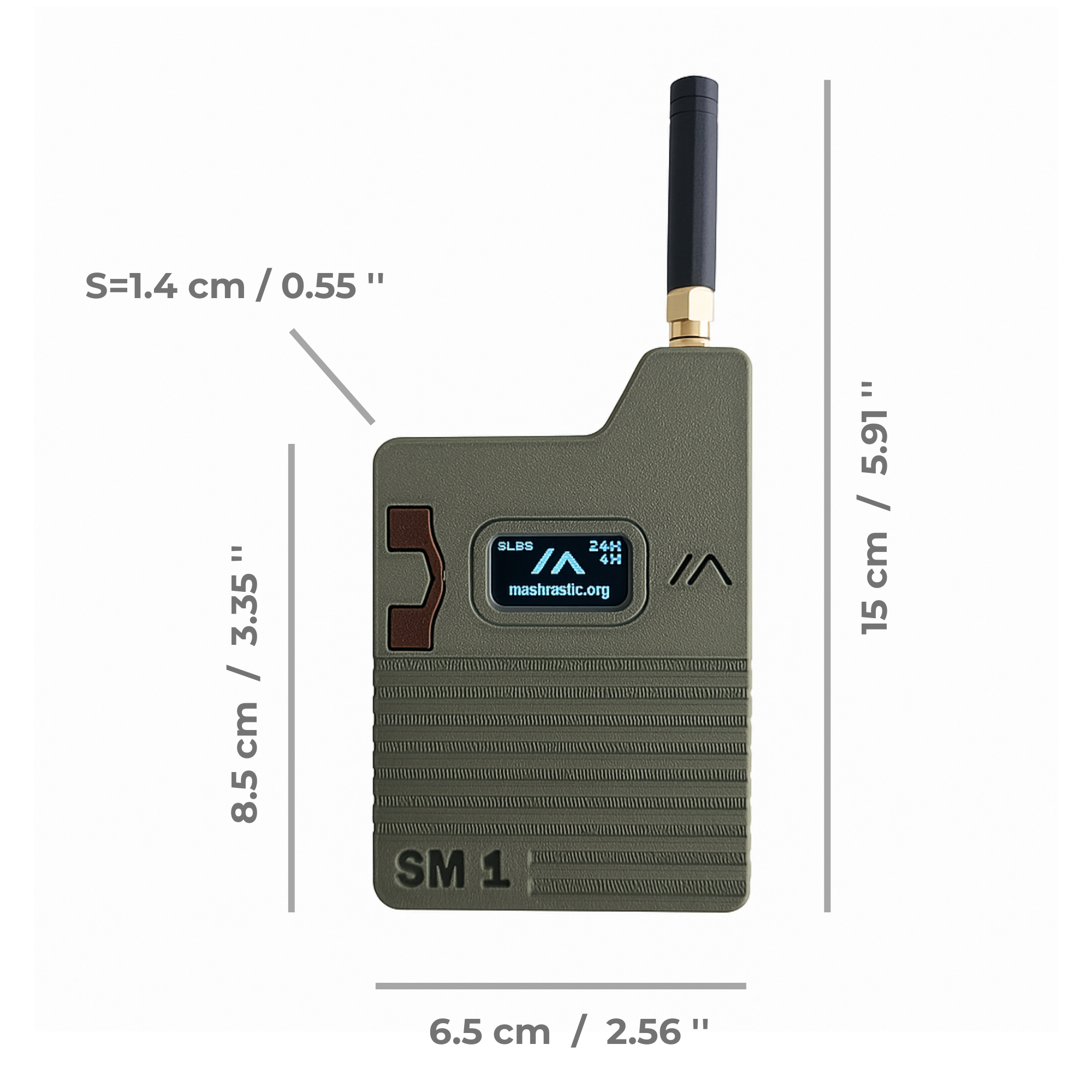
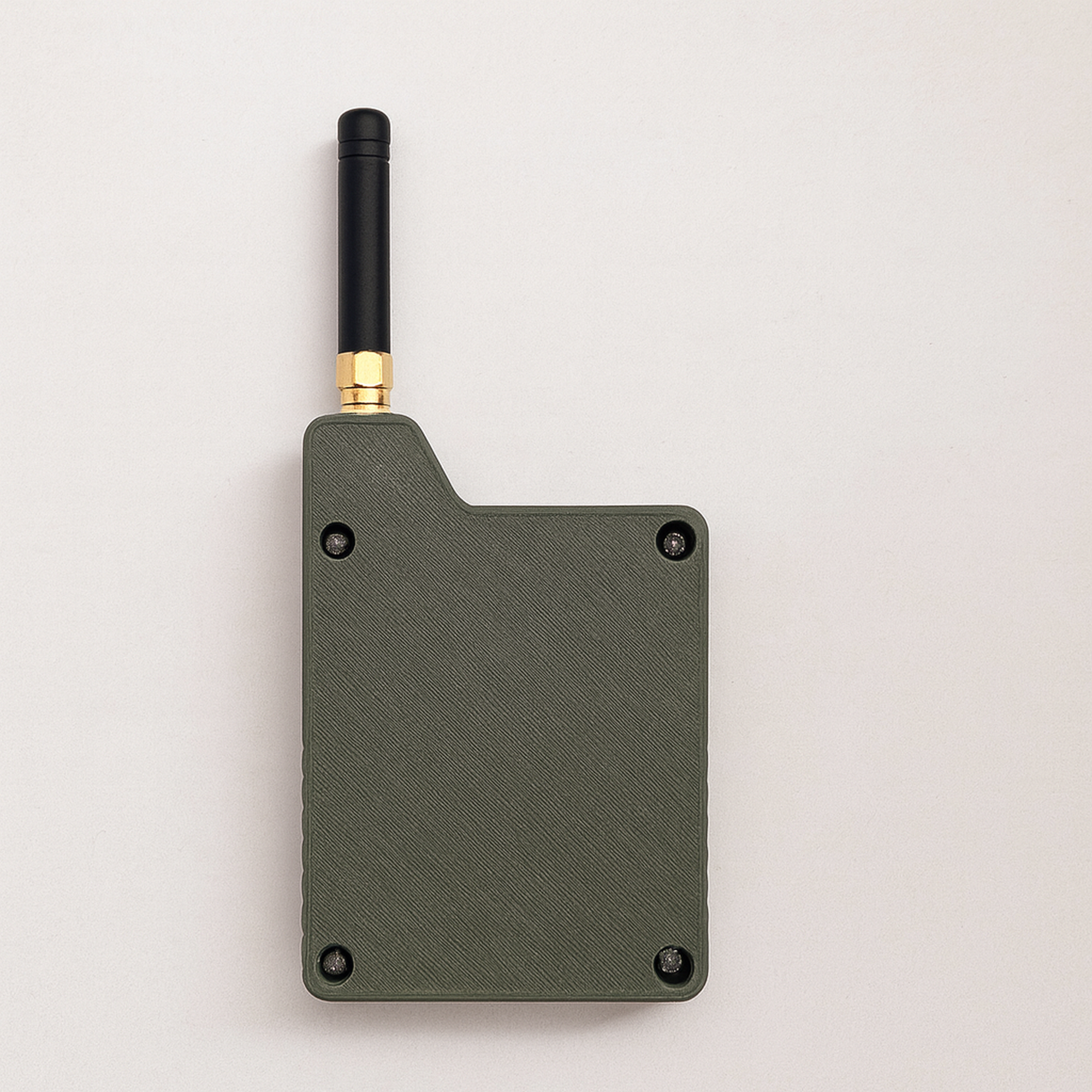
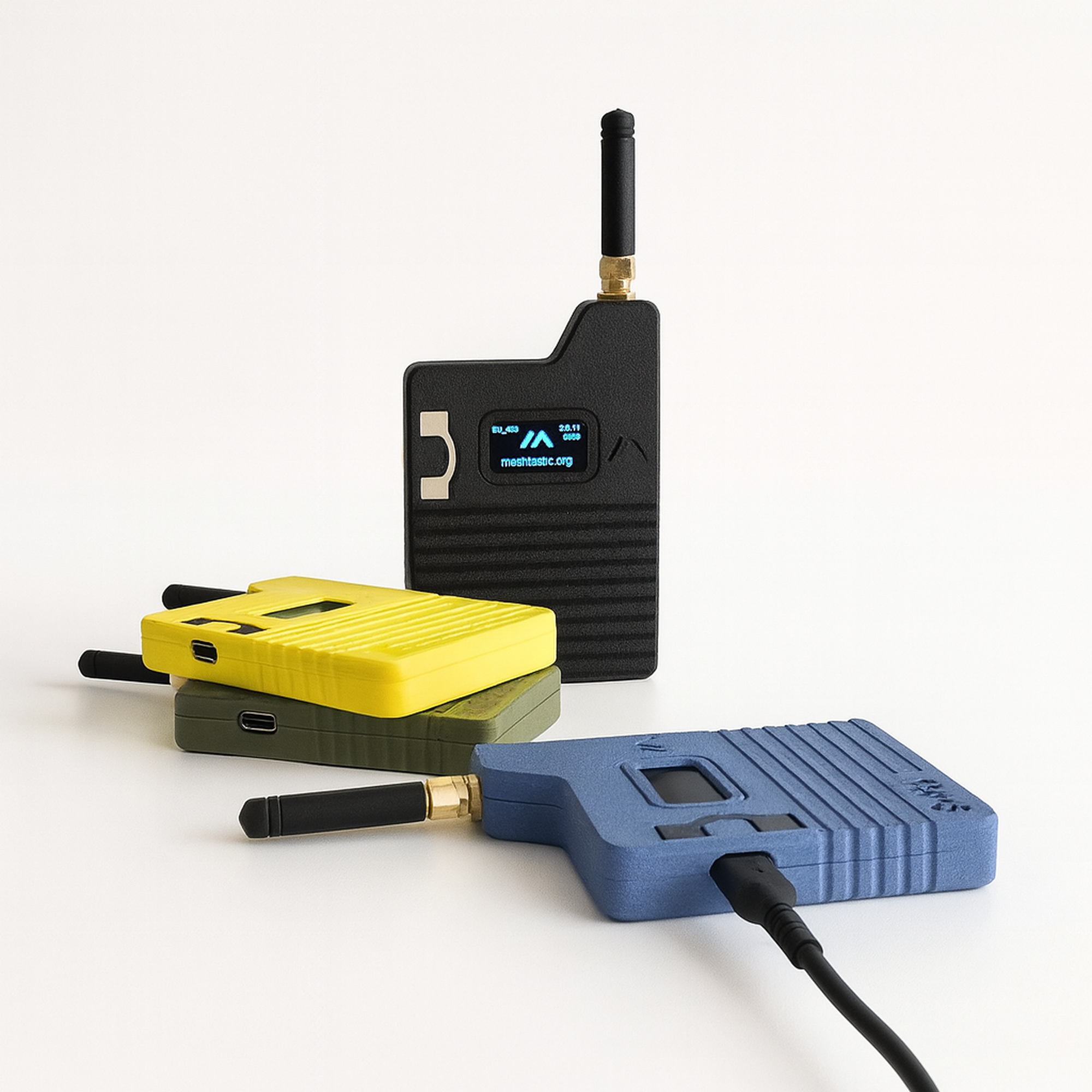
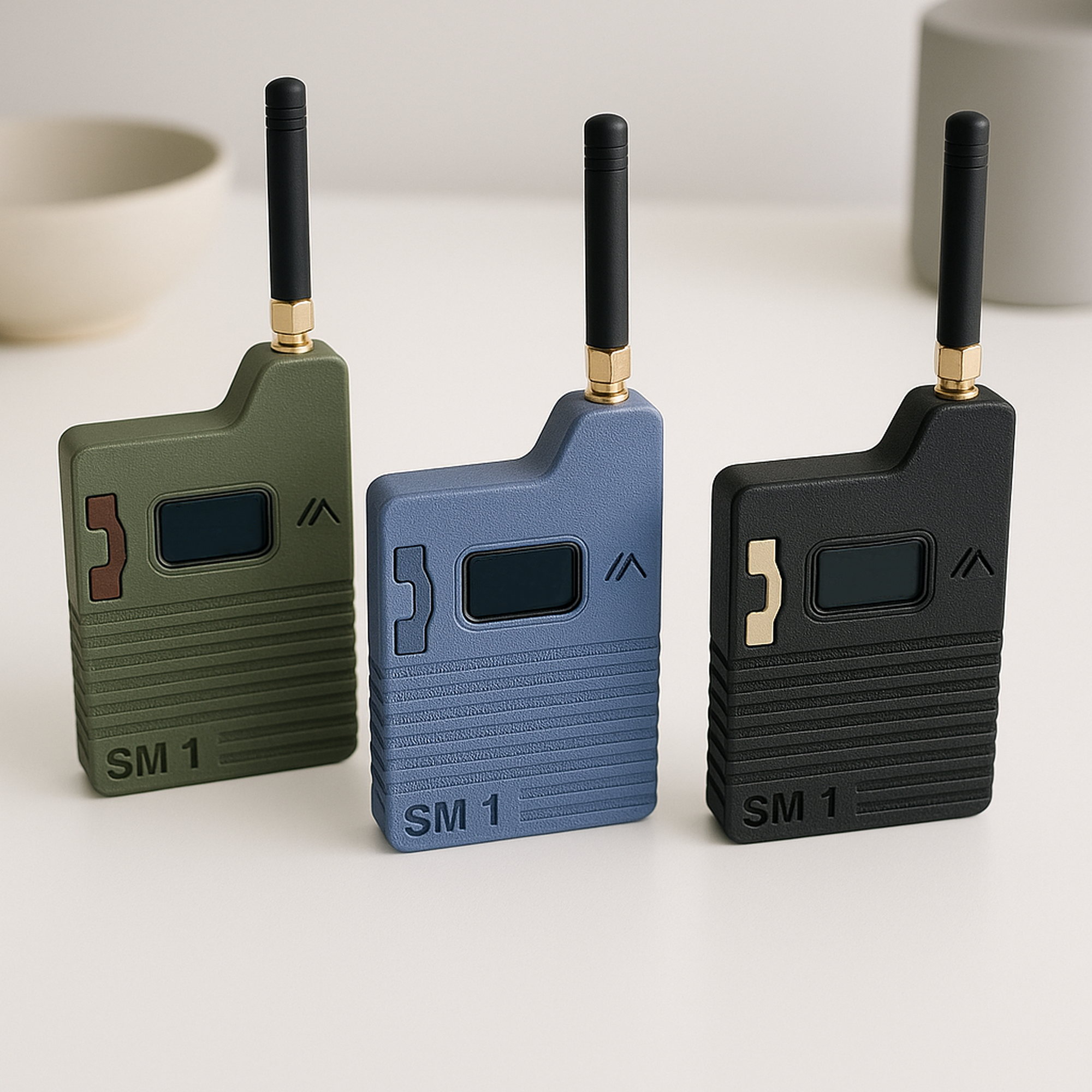
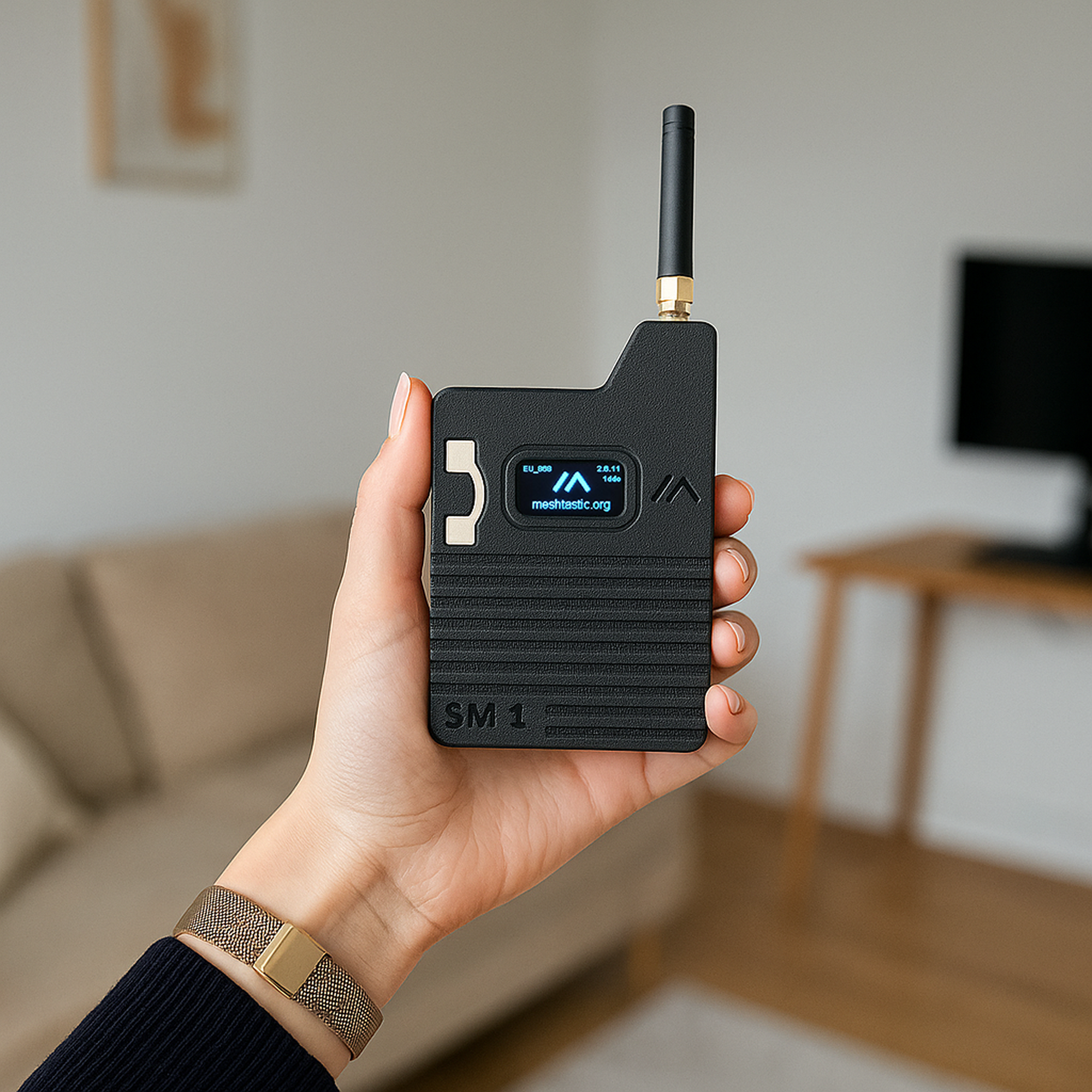
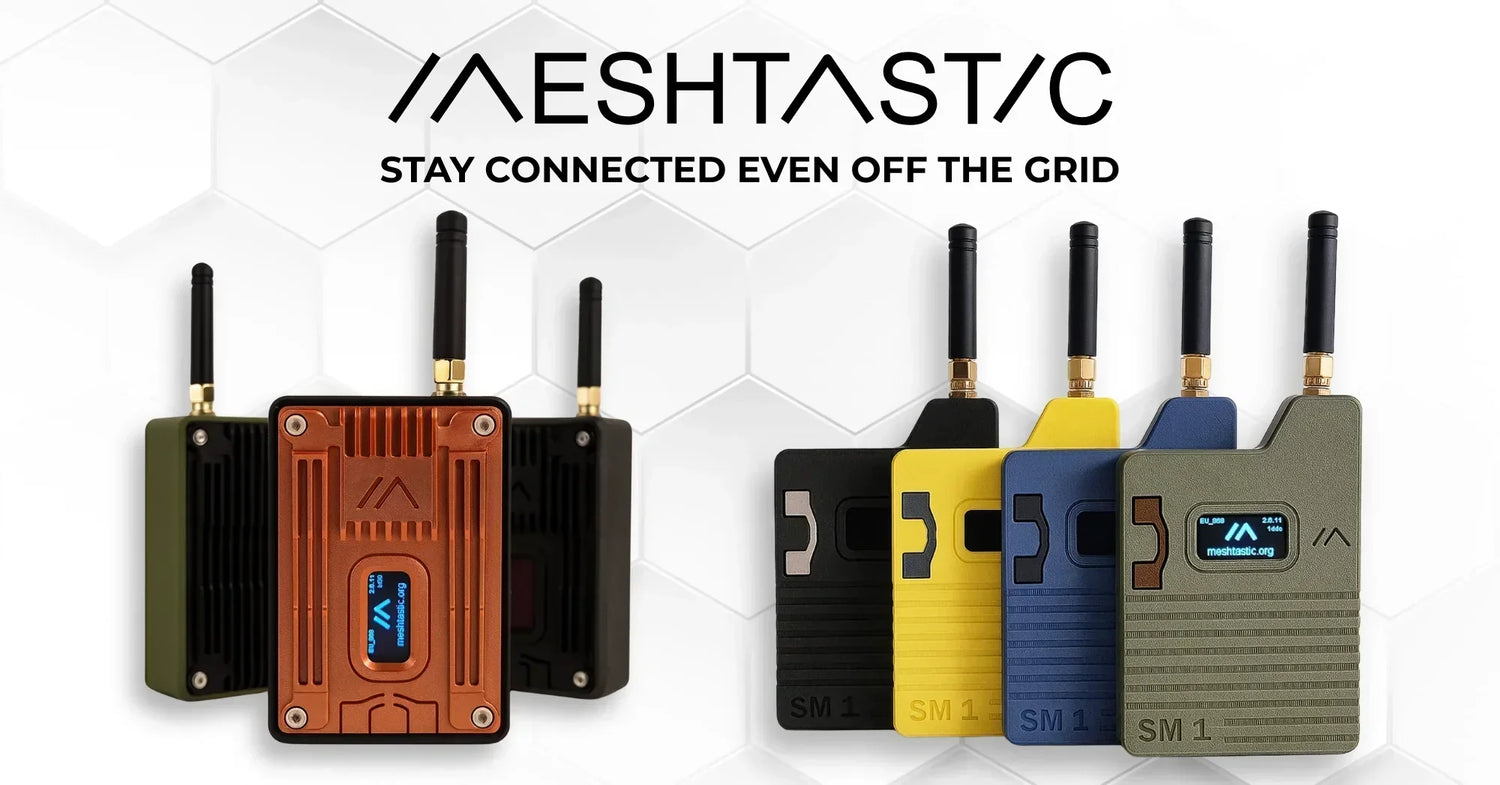
Smartnmagic offers plug-and-play Meshtastic nodes based on the Heltec V3 platform, available in two enclosure styles. Each node ships with the latest Meshtastic firmware pre-flashed for your region (US or EU), a genuine 1500 mAh battery for extended operation, an SMA antenna compatible with popular aftermarket upgrades, a 0.96-inch OLED display, USB-C charging, and two programmable buttons. The devices come in ergonomic, compact PLA enclosures — available in a slim design in multiple colors (black, yellow, blue, olive) or a solid rugged variant (black/copper, black/olive, black). Smartnmagic handles the setup complexity so you can start messaging via the Meshtastic app immediately. Shipping is available throughout Europe and the USA.
muzi works
muzi works focuses on assembled Meshtastic devices with custom-designed enclosures. Their flagship R1 Neo is a Meshtastic Approved Device built on nRF52840 + SX1262 with GPS (complete power switch-off), water-resistant construction, a one-button soft-touch design, built-in buzzer, RTC, and a 1500 mAh protected LiPo with USB-C fast charging (~2 hours). They also sell the H1 (assembled Heltec V3 in carbon fiber PLA case) and H2T (assembled Heltec T114 kit).
Raspberry Pi & Linux Native
Meshtastic supports Raspberry Pi boards through the meshtasticd Linux-native daemon. A Pi-based node requires an external LoRa radio via SPI HATs (MeshAdv-Pi v1.1, Adafruit RFM9x, Elecrow LoRa RFM95 IoT) or USB LoRa adapters (CH341-based, supported since firmware 2.5.18). The Raspberry Pi Pico (RP2040) is also supported as a microcontroller platform. Linux-native deployments are ideal for gateway nodes running additional services or integrating with home automation systems.
Device Comparison Table
| Device | MCU | LoRa | GPS | Display | Battery | ~Price | Best For |
|---|---|---|---|---|---|---|---|
| Heltec V3 | ESP32-S3 | SX1262 | No | OLED 0.96" | External | $18 | Budget entry, MQTT gateway |
| Heltec V4 | ESP32-S3 | SX1262 | Optional | OLED 0.96" | External | $22 | Upgraded V3, higher TX power |
| Heltec T114 | nRF52840 | SX1262 | Optional | TFT 1.14" | External | $15–40 | Low-power solar node |
| Smartnmagic Node | ESP32-S3 | SX1262 | No | OLED 0.96" | 1500 mAh | €62 | Plug & play, ready out of box |
| LILYGO T-Beam | ESP32 | SX1262 | Yes | OLED 0.96" | 18650 slot | $25–35 | Versatile starter device |
| T-Beam Supreme | ESP32-S3 | SX1262 | Yes | OLED 1.3" | 18650 slot | $40–50 | Upgraded all-rounder |
| LILYGO T-Echo | nRF52840 | SX1262 | Yes | E-ink | Built-in | $60 | Outdoor, long battery life |
| LILYGO T-Deck+ | ESP32-S3 | SX1262 | Yes | LCD 2.8" | 2000 mAh | $55–70 | Standalone communicator |
| RAK Starter Kit | nRF52840 | SX1262 | Add-on | Add-on | External | $30–40 | Solar router, modular builds |
| SenseCAP T1000-E | nRF52840 | LR1110 | Yes | No | 700 mAh | $40 | Compact card tracker |
| Wio Tracker L1 Pro | nRF52840 | SX1262 | Yes | OLED 1.3" | 2000 mAh | $43 | Budget handheld with joystick |
| Nano G2 Ultra | nRF52840 | SX1262 | Yes | OLED | External | $70 | Premium portable, RF optimized |
| Station G2 | ESP32-S3 | SX1262 | No | No | No | $100+ | High-power base station |
| ThinkNode M1 | nRF52840 | SX1262 | Yes | E-ink 1.54" | 1200 mAh | $40 | Portable e-ink node |
| ThinkNode M3 | nRF52840 | LR1110 | Yes | No | 770 mAh | $35 | Waterproof card tracker |
| muzi R1 Neo | nRF52840 | SX1262 | Yes | No | 1500 mAh | $60 | Rugged portable, water-resistant |
Prices are approximate and vary by retailer, frequency variant, and included accessories. Always verify current pricing before purchasing.
How to Choose the Right Meshtastic Device
For Beginners on a Budget
The Heltec V3 offers the lowest barrier at under $20 as a bare board, but requires adding a battery and case. For a complete ready-to-use experience without any DIY, Smartnmagic's assembled Heltec V3 nodes come with firmware pre-flashed, a 1500 mAh battery, a case, and an antenna — just turn it on and connect via the app. The SenseCAP T1000-E at ~$40 is another excellent out-of-the-box option, especially for tracking.
For Handheld & Outdoor Use
Battery life and ruggedness are paramount. The LILYGO T-Echo, B&Q Nano G2 Ultra, Elecrow ThinkNode M1, and muzi R1 Neo all use the power-efficient nRF52840 and come in protective enclosures. The T-Echo and ThinkNode M1 add e-ink displays for sunlight readability. For standalone messaging with a keyboard, the LILYGO T-Deck Plus is the obvious choice.
For Solar-Powered Repeaters & Routers
The RAKwireless WisBlock system remains the most proven platform for solar deployments thanks to nRF52840 efficiency and modular solar charging support. The Heltec Mesh Node T114 is a strong alternative with extremely low sleep current (11 µA). Seeed's SenseCAP Solar Node offers a more consumer-friendly integrated option.
For Base Stations & Maximum Range
The B&Q Station G2 stands alone with its 35 dBm PA and superior receiver sensitivity — the preferred choice for community network backbone infrastructure. Pair it with a quality high-gain outdoor antenna at elevation and a single Station G2 can cover an entire region. Operating at these power levels in the US requires an Amateur Radio license.
For Developers & Custom Projects
RAK WisBlock provides maximum flexibility for sensor integrations. Raspberry Pi with meshtasticd offers a full Linux environment. Heltec boards are well-documented and widely used in Arduino and PlatformIO workflows.
Flashing Firmware & Getting Started
Most Meshtastic devices can be flashed using the official Meshtastic Web Flasher, which works directly from Chrome or Edge via WebSerial. Connect your device via USB, select it from the dropdown, choose the firmware version, and flash. Many manufacturers — including Smartnmagic — ship devices with firmware pre-installed.
For nRF52840 devices, updates use UF2 files: enter DFU mode (double-press reset), then drag and drop the firmware file onto the USB drive that appears. ESP32-S3 devices may require download mode (hold BOOT during power-on). OTA updates via Bluetooth are supported through the Meshtastic mobile app.
Once flashed, configure using the Meshtastic app (Android/iOS), the web client, or Python CLI. Set your region, choose a LoRa preset (Long Fast is the default), and join the default channel to begin communicating. If you are new to all this, our step-by-step guide to Meshtastic settings walks through the entire configuration process.
The Evolving Hardware Ecosystem
As of mid-2025, the Meshtastic project has formalized its hardware support into two tiers. Officially Supported devices are backed by manufacturers in the Meshtastic Backer and Partner programs — these receive full support including Web Flasher inclusion, documentation, and client app integration. Community Supported devices continue to receive firmware builds via GitHub releases, but direct support from the core team is limited.
This restructuring reflects the practical challenge of maintaining firmware for 100+ device variants. New devices with improved displays, better battery management, integrated sensors, and novel form factors are announced regularly. The Meshtastic community on Reddit, Discord, and the official forums is an invaluable resource for range tests, battery tips, 3D case designs, antenna recommendations, and troubleshooting.
Frequently Asked Questions
What is the best Meshtastic hardware for beginners?
The Heltec V3 is the most affordable bare board (~$18). For a complete plug-and-play experience, ready-made nodes from Smartnmagic or muzi works come pre-flashed with a battery, case, and antenna. The SenseCAP T1000-E (~$40) is another excellent out-of-the-box option.
What is the difference between ESP32 and nRF52840 for Meshtastic?
ESP32 offers Wi-Fi + Bluetooth with more processing power, but consumes significantly more energy. nRF52840 has only Bluetooth but is extremely power-efficient — ideal for battery-powered and solar deployments with multi-day battery life.
Which LoRa chip should I choose?
The Meshtastic project strongly recommends the newer Semtech SX126x or LR11xx series. They offer better sensitivity, power efficiency, and frequency flexibility than the legacy SX127x chips.
How far can Meshtastic hardware communicate?
Range depends on terrain, antenna quality, and device power. Urban: 1–3 km typical. Open terrain with line-of-sight and good antennas: 10–20+ km. High-power base stations like the B&Q Station G2 extend coverage significantly further.
Can I use Meshtastic without a phone?
Yes. Devices like the LILYGO T-Deck feature a built-in keyboard and screen for standalone messaging. However, most devices are designed to pair with a smartphone via the Meshtastic app for the best experience. Learn more in our beginner's guide to Meshtastic.
Do I need an Amateur Radio license to use Meshtastic?
No — standard Meshtastic devices operate within ISM band power limits and require no license. However, high-power devices like the B&Q Station G2 (above 1 watt) require an FCC Amateur Radio license in the US (Part 97).
Conclusion
The Meshtastic hardware ecosystem has matured into a rich landscape that can accommodate virtually any off-grid communication need — from sub-$20 development boards to 5-watt base stations, from credit-card trackers to pocket communicators with full keyboards.
The key takeaways: choose SX126x or LR11xx LoRa radios over legacy SX127x; pick nRF52840 for battery life and ESP32 for Wi-Fi connectivity; invest in a good antenna; and match your device to your specific use case. Whether you are building a neighborhood mesh for emergency preparedness, tracking assets in the backcountry, or simply exploring long-range radio communication, there is a Meshtastic device perfectly suited to your needs.
If you want to get started without the DIY complexity, browse our ready-to-use Meshtastic nodes — pre-flashed, assembled, and shipping throughout Europe and the USA.